
We could also ask:
Love or Romance?
Let’s do a quick check to see if what you’re in could be—or become—a relationship, or if it’s just an illusion.
And illusions serve a purpose for us, too. If we haven’t experienced genuine emotional closeness with our parents, then we live with a sense of longing: on the one hand, there is the unattainability of (the connection) our loved ones; on the other, even crumbs of their attention are enough to keep our hope alive.
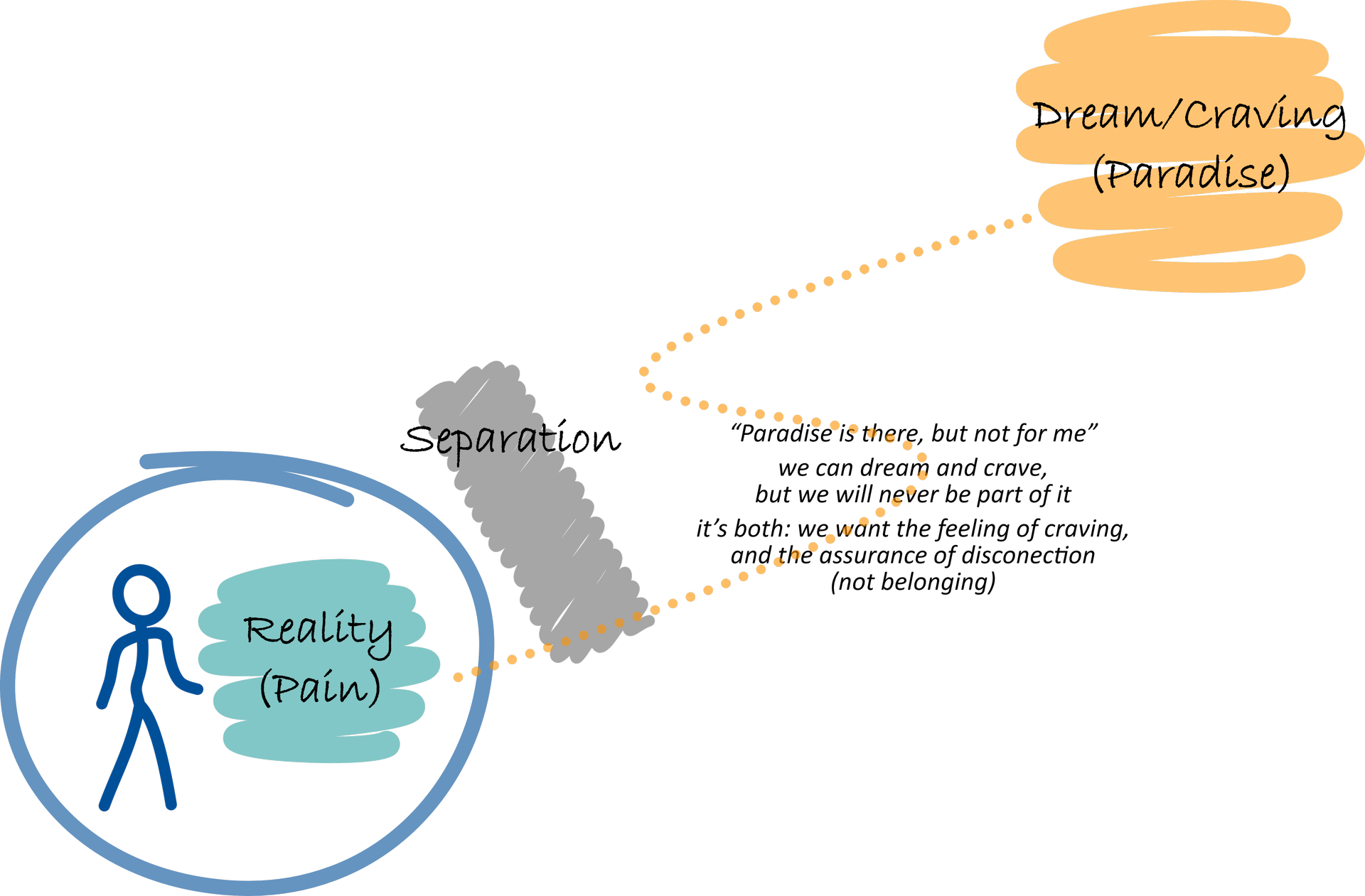
Longing is the addiction to longing
Longing means: We know it will never be fulfilled, but we still want a little bit of that magic. And because that was our default state as children, it becomes our permanent state for life.
So we create states of tension, between dreams and our reality—in such a way that the tension can never be resolved and the dream remains out of reach. The legendary “carrot.”
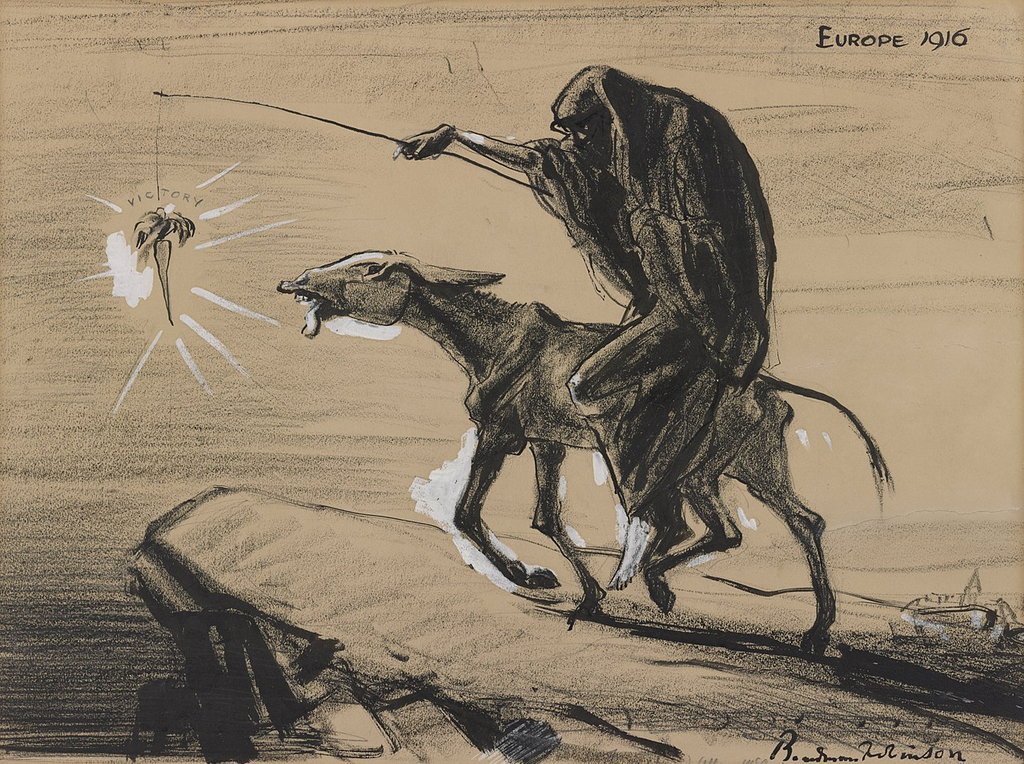
But that’s just a side issue. This is really about relationships.
Relationship?
A relationship begins when we see, hear, understand, and touch one another. But it also begins when we allow ourselves to be seen, heard, understood, and touched.
So I look beyond your walls, masks, roles, and facades. And I let you see me just as I am. That’s what it really means to bare ourselves to one another.
And there has to be a balance. Giving and taking must be in balance for both of us, and in the way we need it to be.
Note: We’re only talking here about give-and-take on the relational level. We’re leaving the material level (everything that ultimately amounts to money and possessions) entirely out of this discussion. The problem with the material level is this: Money is condensed time. There, too, we need a fair exchange of time for time. Otherwise, we end up with an imbalance.
A real “red flag” is when the two levels get mixed up. For example, when I take something on the relational level and give something material in return, or when I take something material and want to give something on the relational level. Because then it’s never really on the relational level—I’m just pretending. It’s a role, but there’s no real closeness.
So both dimensions (or however many there are) must be in balance with each other. The recommendation, however, is to focus on building the relationship first; then everything else can follow. If I start with other aspects, it’s very likely that the relationship won’t develop.
Your needs are just as important to me as my own. There’s a balance there, too. And I’ll give you what you need, not what comes easily to me.
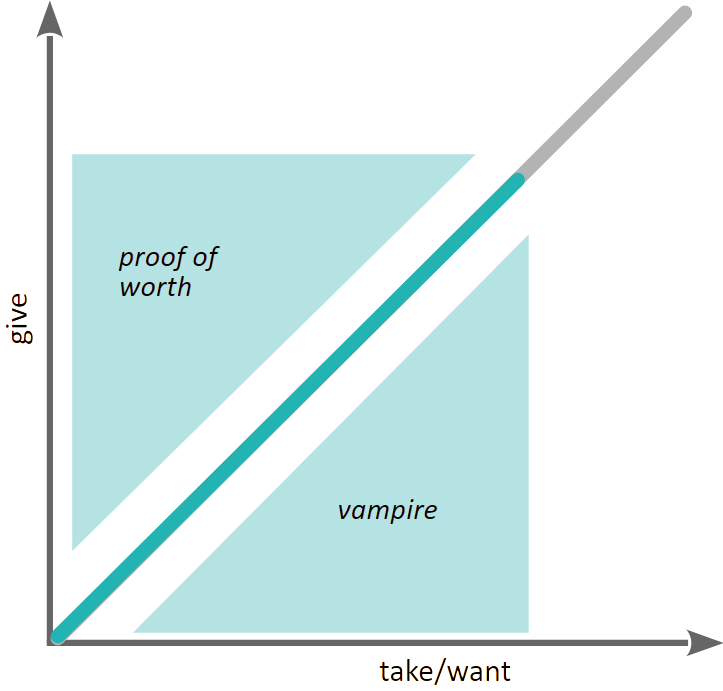
If we look at the picture, it’s about the balance between giving and taking. When I’m in the lower triangle, I’m what the world calls an “asshole.” Technically, I’m in the red, and that makes me a vampire. I’m starving and dying of thirst, and I use everyone to sustain myself.
It’s not about the encounter itself, but only about the feelings I can stir up within myself through you.
Princess?
The most well-known form right now is the „Princess Treatment.“ It stems from an early trauma. I’ve remained stuck at the level of a 3-year-old. I’m a toddler trapped in an adult’s body. (The feminine form includes men as well.)
„I can’t“ and „I’m not“ are hidden behind the role of unconditional expectation.
And only love is unconditional. A relationship can never be unconditional. That’s why parents care for their young children; a relationship often doesn’t develop until later. That said, we often see reciprocity even in young children aged 2–5. They, too, want to help, comfort, and be there for others.
Proof of Value
The top triangle is seen as „heroic,“ but it’s the same pain—just a different strategy. I also have the „I’m not enough“ or „I’m too much“ mindset.
And what comes from that isn’t taking, but rather the need to prove myself: I want to prove my worth! I do and give everything so that I can receive a little affection or validation as a reward.
I seem terribly grown-up because I can do everything, I take action, and I take on responsibility. But I’m really just a kid who needs validation and doesn’t trust anyone.
It’s easy to see that the two triangles complement each other perfectly. In the Diamond Book, you’ll find this under „Diamond.“ It’s the same principle. We look for someone with the same pain but the opposite compensation. That’s what makes it so practical and stable.
We remain stuck in our pain, feeding into those familiar feelings and sustaining the tension of unattainability. To each other, we’re just NPCs. We use each other and never truly connect as human beings.
Balance is the first step
This image suggests that the middle, along the line, is okay. That’s partly true. Balance is best in this setting. The transactions are balanced. Giving and taking are in harmony.
But in doing so, we overlook a small detail that’s already embedded in the diamond: As long as we’re in pain, we’re in a state of lack. We’re managing a bottleneck. That turns us into the ego. (And the person we’re using into an NPC.)
Because it’s never really about the other person. Instead, we force that person into a mold so that they evoke the feelings we want in us. Falling in love or romance turns the other person into an „emotional fulfillment machine.“
And this is the world where people talk about consensus all the time (as an essential part of relationships). I have to constantly protect myself. Defend my boundaries, because we’re always on the verge of crossing them. There’s fear, scarcity, mistrust, and deprivation. Pure survival.
Consensus turns a relationship into a contractual matter—that is, a contract that I can walk away from at any time without having to compensate you. This marks a departure from commitment and accountability in interpersonal relationships. I’m driven solely by my feelings, and they last about 90 seconds.
That’s not stable. It’s as unstable as it gets. It’s a world without trust (especially lack of reliability and integrity). That’s not a relationship. Because a relationship belongs in abundance.
Note: That’s why consensus isn’t a bad thing. But if consensus is an important issue for me, then I’m so far removed from devotion and relationships that I shouldn’t even have a houseplant—I should start with a rock instead.
Balance is good; Dedication is better
The opposite of scarcity is abundance. And none of this is ever a judgment—it is merely an observation.
If you have only a sip of water in your glass and the two of you are walking through the desert, you’ll be very sparing with what you share. So the ego is just the symptom. The inner lack is the cause.
But when you’re lying in a sweet spring, you share generously. And when two springs come together, there’s double the abundance. No one will count how many sips of water each person has drunk.
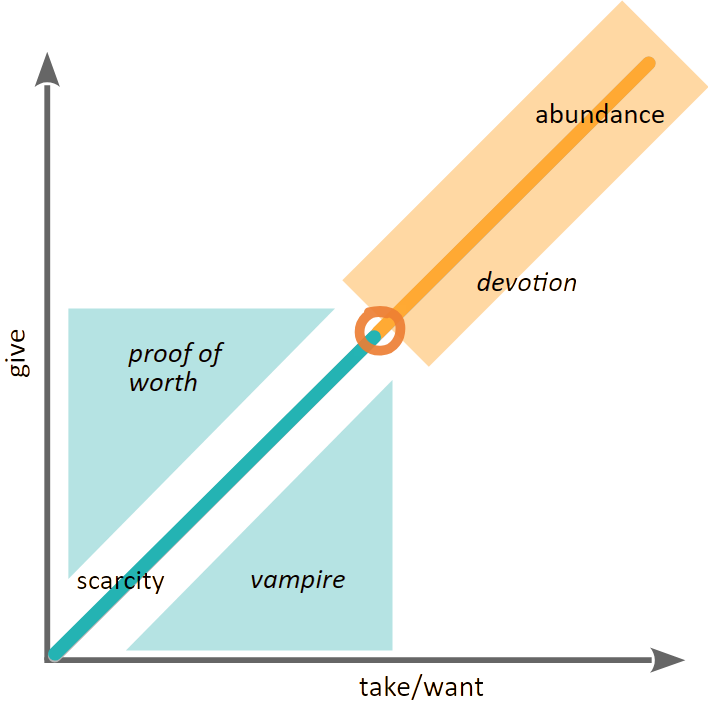
In abundance, giving and receiving are automatically in balance. Those triangles no longer exist.
We only look at the long term to see if someone pulls away from the relationship. However, that’s pretty rare. Real relationships probably never end. The fact that it ends is the best proof that it wasn’t a relationship.
Does sex come with a price tag?
Let’s go back to the world of scarcity.
This applies especially to the girls right now: As soon as you attach conditions or a price tag to your body or sex, you’ve made several things clear:
- You are caught up in sexualization, not in your sexuality. That also means you’re not capable of forming relationships. Because you have (and this wasn’t your choice—others have “shamed” you into it) separated your sexuality from your identity.
- You are living in a scarcity-based reality. And no matter what you are given, there will always be a sense of lack. Because nothing and no one from the outside can fill that inner void. So you have issued a clear warning that life with you will be one of scarcity.
- It’s not about relationships, but about power and control. Ultimately, this is just another way of looking at the „architecture of scarcity.“ Scarcity is the condition, and control is the solution. Based on the idea that „I want you to feel what I feel,“ I seek out people whom I can draw into my own sense of scarcity.
- Sexualization is a self-perpetuating system. It begins with the separation of soul and body (the two cannot exist simultaneously). I use sex to entice, but at the same time I use it to exert control. This creates more alienation. So I distance myself further from the possibility of connection. Soul and body drift further apart, and my assumption (worldview) is confirmed.
Note: This is something you see all the time. Feel free to write in the comments about other things that serve the same purpose. Because whether you’re a man or a woman, we all have our own ways of dealing with things. (And since we’re only interested in germ cells here, that’s why we’re just mentioning men and women.)
Here’s a quick explanation of how our limbic system works. The most important thing is safety. We want to know, “Am I in a safe environment?” To explain this very simply, let’s imagine ourselves as a pack still living in a cave: Do I know that no one here is going to stab me in the back with a knife and eat me? And can I sleep safely here without waking up alone tomorrow, or with everyone fleeing as soon as danger strikes?
Limbi: In a very simple model, we can divide our brain into three parts. The gecko is an ancient, simple, and super-fast system that regulates our survival. The neocortex is our conscious mind. And the limbic system (the Limbi) is our emotional center, which is good at handling complexity and relationships.
In short: Are we there for one another, and do we truly care for one another—even if it costs us something?
And this safety check is going on all the time. How do the people around me feel about me? If they smile, I’m safe. If they look away, ignore me, or yell at me, I’m not safe.
In a so-called relationship, it’s even more important and profound. So does seeing, hearing, understanding, and touching take place? We’re constantly sending signals—both big and small—and watching for a reaction. Are we being drawn toward each other, or are we drifting apart?
We see this clearly in children who want their parents’ attention. They ask questions and whine until they’re noticed. But most of the time, they’re just pushed aside in annoyance or even brushed off with “don’t bother us right now.” All of this is a rejection rather than acceptance. Rejection is a betrayal—a breach of trust or something that prevents trust from forming.
Ultimately, sex is a test of physical connection. “Am I still safe here? Do we still belong together?” And if conditions or a price list come into play (that is, sex as a price or a reward), then the relationship is long over—or never even existed.
Anyone who stays after that has simply never experienced anything better. Everything was always conditional or given as a reward.
TikTok Quiz Questions
There’s also a video (https://vm.tiktok.com/ZGdXbg4UF/) circulating on various platforms that asks a few simple questions. And they’re actually quite helpful. They also reflect some of the ideas mentioned above. Here’s the version for a woman with a partner (F/M). You can then adapt it accordingly: M/F, M/M, F/F.
- If someone tells you, you are like your partner. Is this a compliment?
- Does he make you fully fulfilled or just less lonely?
- Are you in love with the person he is right now, or his potential?
- Can you be your true self (brings lots of examples) around him, or do you have to hide yourself, just to make him comfortable?
- If your daughter would date someone like him, would you be happy for her or would you tell her to run?
What’s exciting isn’t just the answers to these questions, but the fact that you are exactly the same to the other person. The other person is our chosen regulation, which fits our current inner architecture. We „serve“ one another.
A Dream
A friend just told me about an interesting dream. She dreamed about herself and her partner.
In the dream, we were driving through China. In the mountains. Then we came to a fork in the road, and my partner turned right and said, “I know a shortcut.” But the path clearly led toward a precipice.
And so we head toward the abyss and plunge into the depths. We hold hands and say, „I love you so much.“.
When you hear the dream—the story—what message does it convey to you?
Jot that down quickly. Store your answer. And I’m really curious, because so far I only know two different stories. But I’m sure there are more. Feel free to post that as a comment.
Romance
In the Romantic era, this is a symbol of great love that lasts until death.
The Romantics wanted to kill themselves all the time anyway—whether they had a partner or not.
Romanticism is the concept of unfulfilled longing. I long, but in life there is no fulfillment.
Not for what I long for. (Because that has always had a transcendent nature.)
Love
From the perspective of love, it is a warning.
Love is „an unconditional interest in the growth and development of the person I love.“ That includes myself.
And the image of the dream is clear. We’re traveling together, but not in the same direction.
The dreamer’s subconscious is sending a message: Where your partner is heading is the abyss.
Not good for him, but definitely not good for you.
You can try to help him, but you must (!!!) protect yourself. That might mean taking a different route.
This is certainly not a complete list. But it’s enough material for an afternoon to get a sense of where you’re headed.
I wish you a life of abundance.